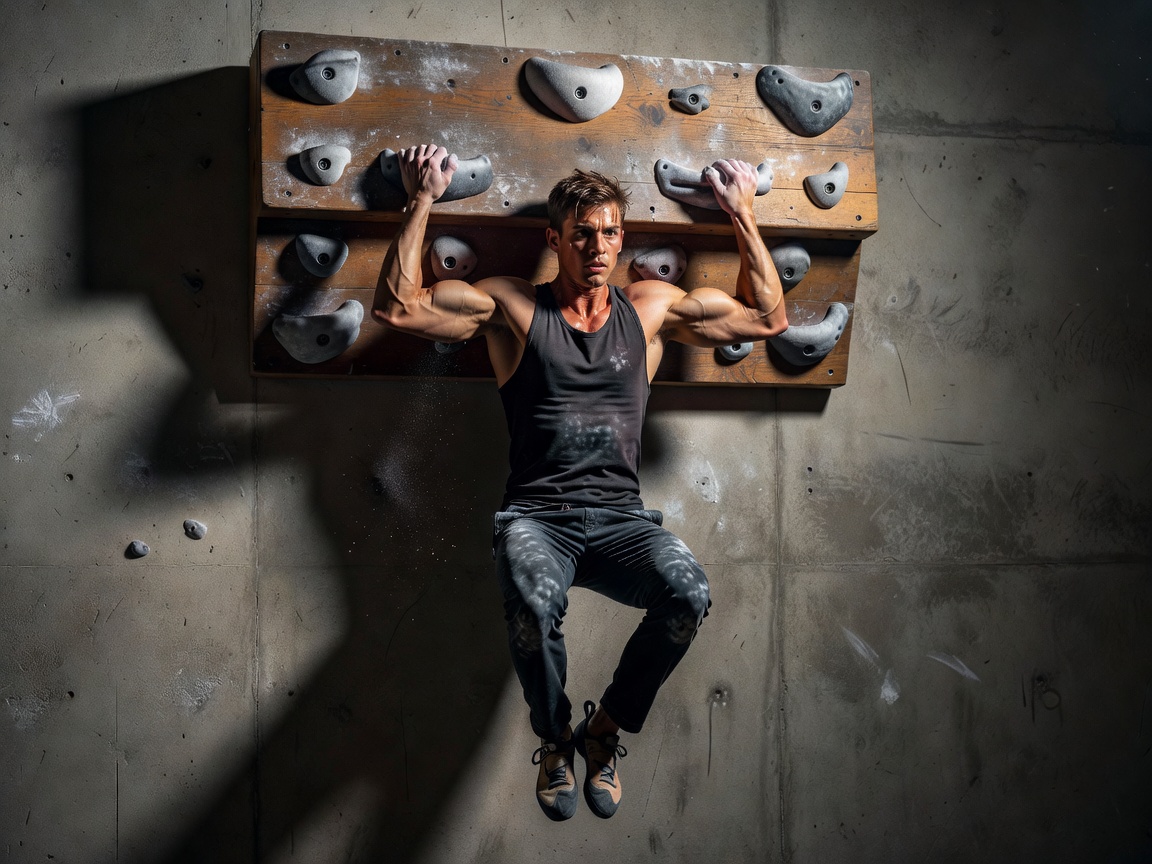
The Foundation: Tendon Adaptation
Muscles adapt and strengthen relatively quickly under stress. Tendons and ligaments, however, lack the massive blood supply of muscles and adapt much slower. A common pitfall for new climbers is rapidly building the back and bicep strength necessary to pull on small holds, but lacking the tendon strength in their fingers to support the load. This imbalance is the primary cause of pulley strains and tears.
Rule Zero of Training: If you have been climbing for less than a year, your training should consist solely of climbing. Avoid specialized training tools until your connective tissues have had time to adapt to basic climbing stress.
Hangboarding (Fingerboarding)
The hangboard is the single most effective tool for increasing raw finger strength. It consists of a piece of wood or resin featuring various edges, pockets, and slopers. By hanging from specific edges for timed intervals, you isolate and overload the flexor tendons.
Max Hangs
Designed for neurological recruitment and peak strength. You select an edge that you can only hold for about 10-12 seconds. You hang for 7-10 seconds, followed by 3 minutes of total rest. Repeat for 3 to 5 sets. This builds sheer force generation.
Repeaters
Designed for strength endurance (power endurance). Using a larger edge, you perform a cycle of hanging for 7 seconds and resting for 3 seconds, repeating this pattern 6 times in a row to complete one set. Rest for 3 minutes between sets. This trains your forearms to recover while lightly pumped.
Core Strength: The Transmission System
In climbing, your fingers connect you to the wall, but your core connects your arms to your legs. If your core sags on an overhanging route, your feet will cut away from the rock, placing your entire body weight on your fingers. A rigid core transfers the power generated by your legs upward through your torso.
Effective core training for climbing focuses on tension and rotational stability rather than crunches:
- Hanging Leg Raises: Hang from a comfortable bar and raise your legs until your toes touch the bar, keeping your legs as straight as possible. Lower them slowly under control.
- Front Levers: An advanced gymnastics move highly applicable to steep climbing. Hanging from a bar, pull your entire body up until it is completely horizontal and parallel to the floor. Start by practicing with tucked knees and slowly extend one leg as you gain strength.
Antagonist Training for Injury Prevention
Climbing is an intensive pulling sport. You are constantly engaging your lats, biceps, and the flexors in your forearms. If you do not actively train the opposing (antagonist) pushing muscles, you will develop severe postural imbalances, often culminating in "climber's hunch" and debilitating shoulder or elbow injuries (like medial epicondylitis, or golfer's elbow).
Incorporate pushing exercises into the end of your climbing sessions:
- Push-ups and Dips: To balance the immense pulling workload on your chest, triceps, and anterior deltoids.
- Overhead Press: Strengthens the stabilizing muscles in the shoulder girdle.
- Finger Extensors: Use a rubber band around the outside of your fingers and practice opening your hand against the resistance to combat the constant gripping motion of climbing.
Rest and Recovery
Training only provides the stimulus for growth; the actual strengthening occurs during recovery. Training hard six days a week will lead to rapid regression and injury. A standard training macro-cycle for intermediate climbers might look like: two days of intense climbing/training, one active rest day (yoga, light cardio), one day of moderate volume, and two full rest days per week.
Listen to your body. Tendon pain is not "weakness leaving the body"—it is a warning sign. Back off at the first sign of sharp joint or finger pain.