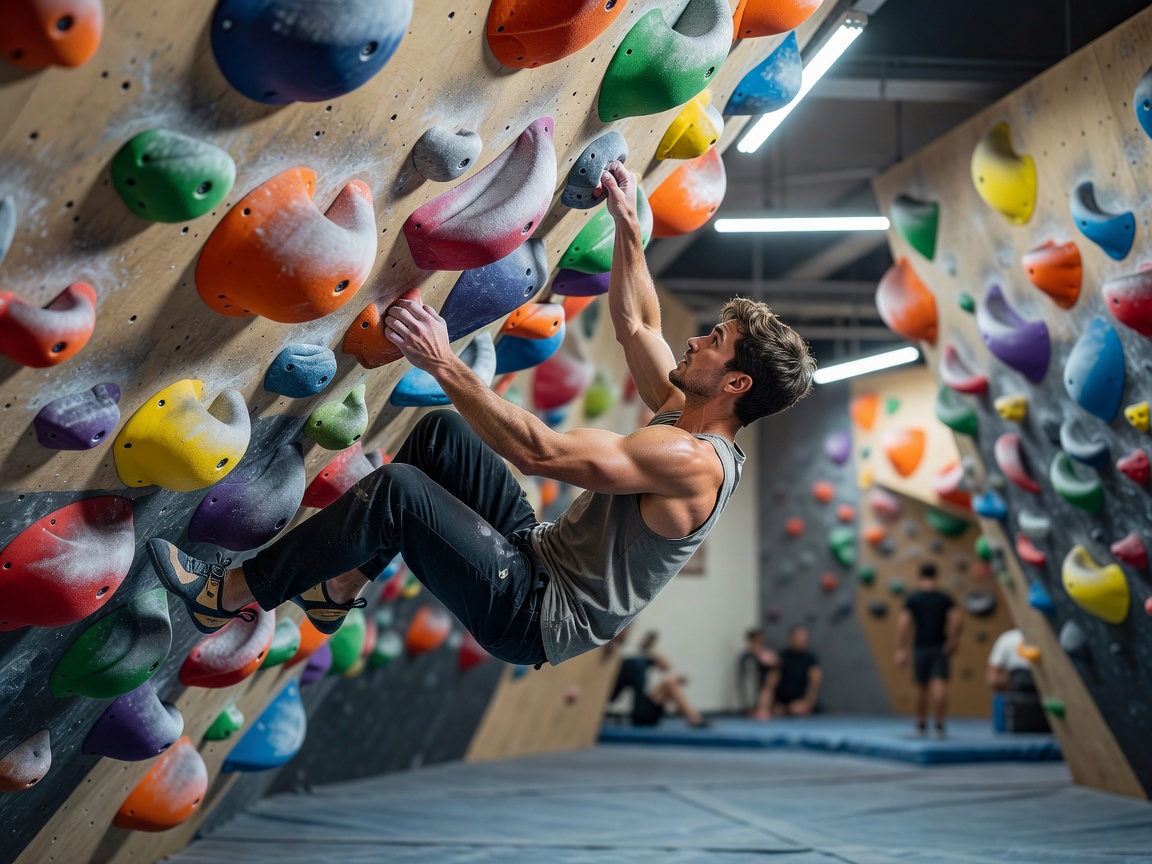
What is Bouldering?
Bouldering is a form of free climbing that is performed on small rock formations or artificial rock walls without the use of ropes or harnesses. While it lacks the dizzying heights of sport or traditional climbing, it makes up for it in intensity. Bouldering routes, usually referred to as "problems," are typically less than 15-20 feet (4-6 meters) tall. The focus is entirely on strength, technique, and problem-solving, making it one of the most accessible and popular entry points into the sport today.
Essential Equipment
One of the major draws of bouldering is the minimal equipment requirement. To get started, you only need three items:
- Climbing Shoes: Unlike regular athletic shoes, climbing shoes are designed to fit snugly—often tightly—around your foot. They feature a specialized, sticky rubber sole that provides immense friction against the wall. For beginners, a flat, relatively comfortable, neutral shoe is strongly recommended over aggressively downturned models, allowing your feet to adjust to the sensation.
- Chalk and Chalk Bag: Sweaty hands are a climber's worst enemy. Magnesium carbonate (chalk) dries your hands and drastically improves your grip on holds. A chalk bag worn around the waist or a larger "bucket" kept on the ground is essential.
- Crash Pad (Outdoor Only): If you venture outside, you will need a crash pad—a thick, portable foam mattress to protect your falls. Indoors, the entire floor is heavily padded, eliminating this requirement.
Basic Bouldering Techniques
Success in bouldering rarely comes down to brute upper-body strength. Efficient climbing relies heavily on footwork and body positioning. Consider these foundational techniques:
Edging and Smearing
Edging involves placing the inside or outside edge of your climbing shoe onto a defined hold. You must press down through your big toe, maintaining tension to keep your foot secure. Smearing is used when there are no positive footholds; instead, you press the rubber sole of your shoe flat against the wall, relying entirely on the friction of the rubber and the pressure you apply.
Straight Arms
A common beginner mistake is keeping the arms constantly bent in a pull-up position. This rapidly exhausts the biceps. Instead, try to keep your arms straight whenever possible, hanging off your skeletal structure and tendons rather than your muscles. Use your legs—which are much stronger than your arms—to push yourself upward.
Flagging
Balance is critical on the wall. Flagging involves extending a leg out to the side (without placing it on a hold) to shift your center of gravity and prevent yourself from swinging uncontrollably like a barn door opening.
Gym Etiquette and Safety
Indoor bouldering gyms are communal spaces. Observing basic etiquette ensures a safe environment for everyone:
- Check Your Fall Zone: Before getting on the wall, look up and down. Never walk underneath someone who is climbing, and never start a problem that crosses paths with a climber already on the wall.
- Learn How to Fall: Falling is an integral part of bouldering. When you fall, try to land on both feet with your knees slightly bent to absorb the impact, and immediately roll backward onto your glutes and back. Never brace your fall by sticking your arms straight out behind you, as this can lead to severe wrist and elbow injuries.
- Brush the Holds: Excess chalk and boot rubber make holds slippery. Most gyms provide brushes on long sticks. If you have been projecting a boulder problem, brush the holds before you move on so the next climber has adequate friction.
- Respect the Queue: If an area is busy, take turns. Rest adequately between attempts, and allow others to try their problems while you recover.
Grading Systems in Bouldering
In North America, bouldering problems are primarily graded using the V-Scale (Hueco scale), which starts at V0 (easiest) and currently tops out around V17 for world-class athletes. In Europe and many other parts of the world, the Fontainebleau (Font) scale is standard, beginning at 3 and extending into the 9s (e.g., 9A). As a beginner, expect to spend your first several months climbing in the V0 to V2 (Font 4 to 5+) range while your body adapts to the specific strains of the sport.
Ready to Gear Up?
Before you hit the gym, familiarize yourself with the equipment you'll encounter on your climbing journey.
Read the Gear Guide