The Safety Standard: UIAA and CE Certifications
Before purchasing any life-supporting climbing equipment, you must ensure it bears the appropriate safety certifications. The International Climbing and Mountaineering Federation (UIAA) sets rigorous safety standards for climbing gear globally. Similarly, the CE (Conformité Européenne) mark indicates compliance with European safety standards. Never purchase unbranded, uncertified climbing gear from generic online marketplaces. The integrity of your harness, rope, and carabiners is literally a matter of life and death.
The Climbing Harness
A climbing harness consists of a waistbelt, two leg loops, a belay loop, and gear loops. When fitting a harness, the waistbelt should sit above your hip bones; you should not be able to pull the harness down over your hips once tightened. Modern harnesses utilize double-back buckles which are incredibly secure, but always check your harness manual to ensure you are fastening it correctly. Look for harnesses with adjustable leg loops if you plan to climb in cold weather wearing varying layers of clothing.
Belay Devices and Locking Carabiners
To belay a climbing partner—managing their rope to catch falls and lower them safely—you need a belay device and a large locking carabiner. Belay devices generally fall into two categories:
- Tubular Devices (e.g., ATC): These are the standard entry-level devices. They operate entirely on friction created by bending the rope through the device and over the carabiner. They demand constant vigilance from the belayer, as letting go of the brake strand will result in an immediate drop.
- Assisted-Braking Devices (e.g., Petzl Grigri): These devices feature a camming mechanism that pinches the rope when a sudden force is applied, assisting the belayer in catching the fall. While they provide an extra layer of security, they are not hands-free; the belayer must still maintain control of the brake strand at all times.
Your belay device attaches to your harness's belay loop via a locking carabiner. A large, HMS (pear-shaped) locking carabiner is ideal, as its wide top radius accommodates the rope smoothly.
The Climbing Rope
Climbing ropes are marvels of modern engineering. Unlike static ropes used in hauling or caving, climbing ropes are dynamic. This means they are designed to stretch significantly under load, absorbing the kinetic energy of a falling climber and reducing the impact force transmitted to the climber, the belayer, and the gear in the rock.
When selecting a rope for sport climbing or gym use, look for a single dynamic rope (identified by a circled '1' on the label) with a diameter between 9.5mm and 10.0mm. Thinner ropes are lighter and flow through carabiners easily but wear out faster. Thicker ropes are more durable and easier to grip while belaying, making them excellent choices for beginners.
Quickdraws (For Sport Climbing)
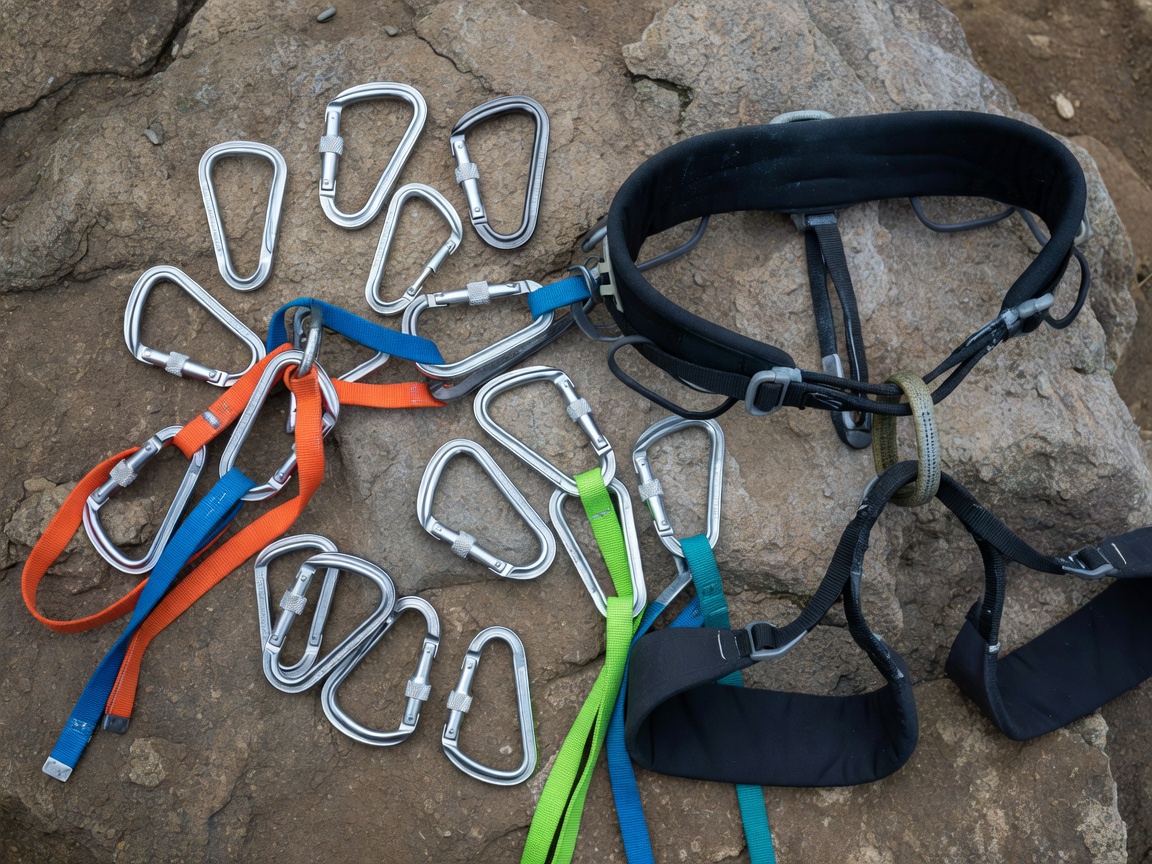
If you plan to climb outdoor sport routes, you will need a rack of quickdraws. A quickdraw consists of two non-locking carabiners connected by a short, sturdy sling (the "dogbone"). One carabiner clips into the permanent metal bolt on the rock wall, while the other carabiner accepts your climbing rope. A standard rack for sport climbing typically requires 10 to 14 quickdraws, depending on the length of the routes you intend to climb.
Helmets
Climbing helmets are essential for outdoor climbing. They protect your head not just from falling rock or dropped gear from climbers above, but also from impacting the rock wall during a severe fall. Modern helmets are constructed using EPS (expanded polystyrene) foam covered by a thin polycarbonate shell, offering excellent energy absorption at a very low weight.
Gear Maintenance and Retirement
Climbing gear does not last forever. Soft goods—like harnesses, ropes, and slings—degrade over time due to UV exposure, dirt, and general wear. Most manufacturers state a maximum lifespan of 10 years for soft goods, even if perfectly stored and unused. With regular use, a rope or harness may need replacing in 1 to 3 years. Hard goods (carabiners, belay devices) can theoretically last indefinitely, but must be retired if they are dropped from a significant height, develop sharp grooves from rope wear, or if the gate mechanisms fail to close smoothly.
Taking Gear Outdoors
Ready to pack your newly acquired gear and head to the crag? Ensure you know the differences between the gym and the great outdoors.
Explore Indoor vs Outdoor